Before Arthur is a king he is a boy with a sword that breaks. The Matter of Britain hinges on what happens next — not on the pulling of one blade from a stone, but on the giving of another, by a hand that comes up out of water.
I · The Broken BladeA king without a sword
Arthur had taken the crown by pulling the sword Clarent from the stone in the churchyard at London — the first proof, the public proof, that the old king's blood ran in him. He carried it into his first real war, against the eleven northern kings who would not bow to a boy, and on the field at Bedegraine he broke it on a giant's shield.
Half the blade went into the mud. The hilt he kept. He rode back through his own lines with the useless gold of it in his hand, and his wizard riding beside him, and his face, for the first time in his reign, uncertain.
II · The Counsel of Merlin“Wait. The lake will answer.”
Merlin said: there is another sword. Older than the churchyard one, older than the Romans who had built the churchyard. Forged in Avalon, given to no man yet, kept for a king who would need it on a day exactly like this one.
Where, said Arthur.
Merlin did not point. He turned his horse off the road and rode west until the ground softened, and the road became a track, and the track became no track at all, only ferns and the smell of water. By dusk they had come to the edge of a lake so still it carried the cloud above it like a second sky. Arthur dismounted. Merlin said: Wait. The lake will answer.
III · The LadyWhite as river-ice
The lake answered. A wind that had not been there moved across the water, and where it touched, the mist drew apart in long ribbons. Out of the place the mist had been, a woman walked toward the shore without disturbing the surface, her gown trailing in the water as if the water were carrying it for her. Her hair was the colour of the moon on tin. She was crowned in small flowers Arthur did not recognise.
This was the Lady of the Lake, whom older books call Nimue, or Viviane, or by a name in a language no one alive still spoke. Merlin had taught her, in younger centuries, half of everything he knew. She would teach him, in older ones, the last lesson he would learn.
She did not bow to Arthur, and she did not need to.
IV · The HandFrom the deep, a blade
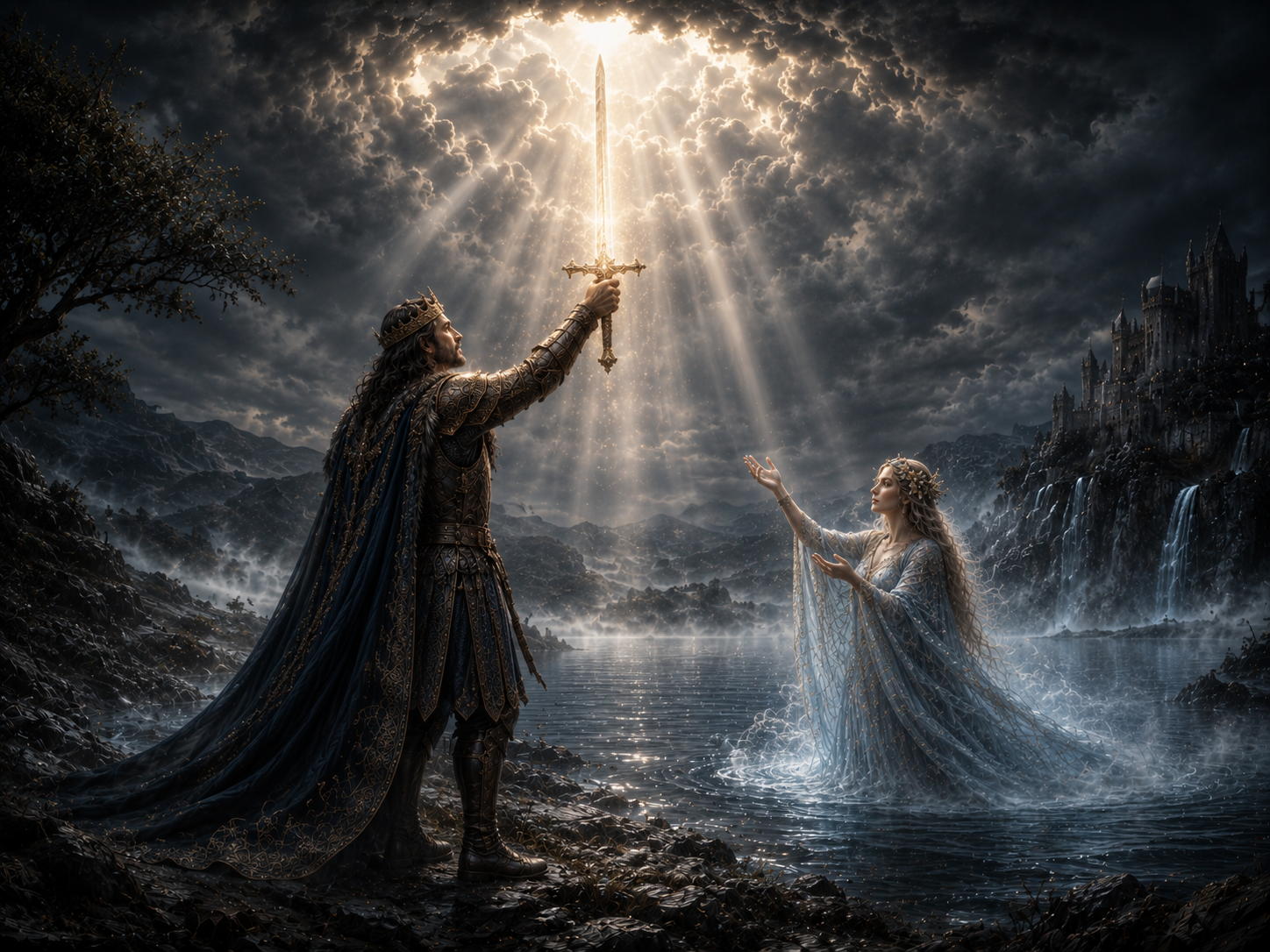
She raised her arm, and out of the middle of the lake another arm rose beside Arthur's reflection. White, slender, wearing a sleeve of white samite — a luxurious, heavy silk fabric, woven with silver threads. The hand at the end of it held a sword above the water as if it weighed nothing.
The blade was long and clean and the colour of the sun seen through cold water, and along both edges runes had been cut so finely they looked at first like watermarks. One edge said TAKE ME UP. The other said CAST ME AWAY. The pommel was a knot of gold worked with no beginning and no end.
That is Excalibur, the Lady said. It is mine. I will give it to you, and in time you will give it back, because no thing of mine stays out of the water long.
V · The TakingArthur kneels — and rises
Arthur waded out. He took the hilt in both hands.
He stood. He lifted the sword above his head. The cloud above the lake parted for an instant and laid a single shaft of late sun along the blade, and the runes caught it and threw it back in the colour of fire. Merlin, on the bank, said nothing. He had seen many kings made, and most of them by accident; he knew what it looked like when one was made on purpose.
VI · The ScabbardThe better of the two gifts
The Lady gave him, after the sword, the scabbard. It was sewn of dark leather and stitched with thread the colour of the inside of a shell. She told him plainly that it was the better gift of the two.
While you wear this, she said, no wound shall bleed you dry. Cuts will close. Spears will not find your heart. You may lose battles and lose blood, but you will not lose your life as long as the scabbard is on your hip.
Arthur thought she meant the sword was the great thing and the scabbard was a courtesy. He was wrong. Years later, when his sister Morgan stole the scabbard and threw it into a different lake, every wound he had ever shrugged off began, quietly, to count again.
VII · The ReturnAnd the lake takes it back
At the end of his life, on the field at Camlann, Arthur lay with a wound the scabbard would have closed for him, had he still owned it. He sent his last knight, Bedivere, to the nearest water with Excalibur, and told him to throw the sword in.
Bedivere, twice, could not. The blade was too beautiful, the loss too final. Twice he hid it in the rushes and came back and lied about what he had seen. Twice Arthur, dying, knew. On the third trip Bedivere closed his eyes and threw, and out of the water rose, again, a hand in white samite, and caught the sword by the hilt, and brandished it three times, and drew it under.
Take me up, the blade had said. Cast me away. Arthur was the only person who ever kept both halves of that promise.
VIII · GlossaryThe water-given things
Excalibur
The sword given by the Lady. Said never to be dulled. Its two edges carry the commands by which Arthur lives and ends his reign.
The Lady of the Lake
The water-spirit who keeps the sword in the lake. Teacher of younger Merlin, foster-mother of Lancelot, and in the end the woman who closes Merlin in his cave of stone.
Merlin
Prophet and king-maker. He knows where the lake is, and what the Lady will do, and that he himself will not see the end of the reign he is starting.
The Scabbard
Plainly sewn, plainly given. While Arthur wears it, no wound bleeds him to death. Morgan le Fay will steal it long before he understands what he has lost.
Avalon
The island where Excalibur was forged and where, mortally wounded, Arthur is finally rowed away to wait for the country that will need him again.
Caledfwlch
The older Welsh name for the same sword. A cousin of the Irish Caladbolg. The Latin Caliburnus and the French Excalibur are both softenings of this earlier word.